



Video Training →Polymers Asset To Human Race
Published by: FreshWap.CC on 9-06-2022, 12:54 |  0
0
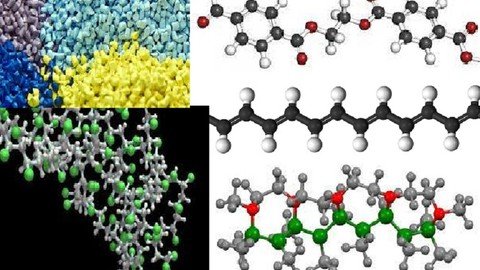
Last updated 5/2022
MP4 | Video: h264, 1280x720 | Audio: AAC, 44.1 KHz
Language: English | Size: 1.07 GB | Duration: 1h 49m
Polyester
What you'll learn
The students will get a wide picture of Polymers.
The students will learn about the Polymers found naturally in environment.
The students will have a deep knowledge about the extraction and preparation of Polymers.
The students will know about the importance of natural and synthetic polymers.
Requirements
The child should have a clear concepts of natural products.
Description
Natural polymers: The polymers which occur in nature i.e., which occur either in plants or animals, are called natural polymers. For example, natural rubber, proteins, cellulose, starch (polysaccharides), wood, silk and nucleic acids are natural polymers.Synthetic polymers: Synthetic polymers are man-made polymers. Thesepolymers are made in laboratories or factories. Typical examples of synthetic polymers include polyethene, PVC, nylon, terylene, Teflon, synthetic rubber, Bakelite and melamine.Semi-synthetic polymers: Chemically modified natural polymers are called semi-synthetic polymers. For example, nitrocellulose, cellulose acetate etc. are termed semi-synthetic polymers. These polymers are also called chemically modified natural polymers.Linear chain polymers: The polymers m which the constituent monomers link with each other to form a long straight chain are called linear chain polymers, or straight chain polymers.Linear polymers are well packed and thus have high densities, high tensile strength and high melting points. For example, high-density polythene (HDPE) is a linear chain polymer.Branched chain polymers: The Polymers which have side-chains attached to the linear chains consisting of monomers are called branched chain polymers.The branched chain polymers are irregularly packed and thus have lower tensile strength, lower melting point and lower density. For example, low-density polythene (LDPE) has lower density, lower melting point and lower tensile strength than the linear high-density polythene (HDPE).
Overview
Section 1: Introduction
Lecture 1 15.1. Contents of Polymers
Lecture 2 15.2. Introduction of Polymers
Lecture 3 15.3. Classification of Polymers on the Basis of Origin
Lecture 4 15.4. Cross-linked polymers
Lecture 5 15.5. Thermosetting polymers
Lecture 6 15.6. Chain Growth Polymerization
Lecture 7 15.7. Copolymerization
Lecture 8 15.8. Preparation of Condensation Polymers
Lecture 9 15.9. Melamine Formaldehyde Resin
Lecture 10 15.10. Polymers as Pollutants
For the Beginners and students of twelfth standard.
Homepage
https://www.udemy.com/course/polymers-q/

https://rapidgator.net/file/1f3f13fd7cc4fd4b149a0e8a3e02f6f5/mpiur.Polymers.Asset.To.Human.Race.part2.rar.html
https://rapidgator.net/file/f08a814f452c7d094a039c5da0659235/mpiur.Polymers.Asset.To.Human.Race.part1.rar.html
H4S
https://hot4share.com/twvlv1k7fpqa/mpiur.Polymers.Asset.To.Human.Race.part2.rar.html
https://hot4share.com/zxibqnzx2yxf/mpiur.Polymers.Asset.To.Human.Race.part1.rar.html

https://nitro.download/view/16187FF8B240C0E/mpiur.Polymers.Asset.To.Human.Race.part2.rar
https://nitro.download/view/49B1D59ECC57966/mpiur.Polymers.Asset.To.Human.Race.part1.rar

https://uploadgig.com/file/download/322cb3ab7Ff9Ad7b/mpiur.Polymers.Asset.To.Human.Race.part2.rar
https://uploadgig.com/file/download/5c49B45e6C7a10C8/mpiur.Polymers.Asset.To.Human.Race.part1.rar
Links are Interchangeable - No Password - Single Extraction
Help Us Grow – Share, Support
We need your support to keep providing high-quality content and services. Here’s how you can help:
- Share Our Website on Social Media! 📱
Spread the word by sharing our website on your social media profiles. The more people who know about us, the better we can serve you with even more premium content! - Get a Premium Filehost Account from Website! 🚀
Tired of slow download speeds and waiting times? Upgrade to a Premium Filehost Account for faster downloads and priority access. Your purchase helps us maintain the site and continue providing excellent service.
Thank you for your continued support! Together, we can grow and improve the site for everyone. 🌐
Related News
-
{related-news}
Comments (0)

Information
Users of Guests are not allowed to comment this publication.
Search
Updates
Partner
» TutBB
» Byte
» Crawli
» Warezomen
» Warez-DDL
» Raidrush
» KATZCD
» Free Ebooks Library
Your Link Here ?
(Pagerank 4 or above)
» Byte
» Crawli
» Warezomen
» Warez-DDL
» Raidrush
» KATZCD
» Free Ebooks Library
Your Link Here ?
(Pagerank 4 or above)