



E-Books →Dynamic Data Processing Recursive Least-squares, 2nd Edition
Published by: book79 on 6-06-2025, 06:00 |  0
0
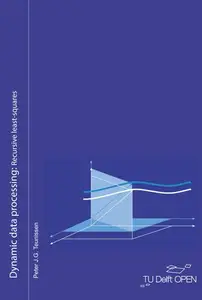
Free Download Dynamic Data Processing: Recursive Least-squares, 2nd Edition
Peter J.G. Teunissen
English | 2024 | ISBN: 9463669167 | 253 Pages | PDF | 11.3 MB
This book is a follow-up on Adjustment theory. It extends the theory to the case of time-varying parameters with an emphasis on their recursive determination. Least-squares estimation will be the leading principle used. A least-squares solution is said to be recursive when the method of computation enables sequential, rather than batch, processing of the measurement data. The recursive equations enable the updating of parameter estimates for new observations without the need to store all past observations. Methods of recursive least-squares estimation are therefore particularly useful for applications in which the time-varying parameters need to be instantly determined. Important examples of such applications can be found in the fields of real-time kinematic positioning, navigation and guidance, or multivariate time series analysis. The goal of this book is therefore to convey the necessary knowledge to be able to process sequentially collected measurements for the purpose of estimating time-varying parameters. When determining time-varying parameters from sequentially collected measurement data, one can discriminate between three types of estimation problems: filtering, prediction and smoothing. Filtering aims at the determination of current parameter values, while smoothing and prediction aim at the determination of respectively past and future parameter values. The emphasis in this book will be on recursive least-squares filtering. The theory is worked out for the important case of linear(ized) models. The measurement-update and time-update equations of recursive least-squares are discussed in detail. Models with sequentially collected data, but time-invariant parameters are treated first. In this case only the measurement-update equations apply. State-space models for dynamic systems are discussed so as to include time-varying parameters. This includes their linearization and the construction of the state transition matrix. Elements from the theory of random functions are used to describe the propagation laws for linear dynamic systems. The theory is illustrated by means of many worked out examples. They are drawn from applications such as kinematic positioning, satellite orbit determination and inertial navigation.
Buy Premium From My Links To Get Resumable Support,Max Speed & Support Me
Links are Interchangeable - Single Extraction
Help Us Grow – Share, Support
We need your support to keep providing high-quality content and services. Here’s how you can help:
- Share Our Website on Social Media! 📱
Spread the word by sharing our website on your social media profiles. The more people who know about us, the better we can serve you with even more premium content! - Get a Premium Filehost Account from Website! 🚀
Tired of slow download speeds and waiting times? Upgrade to a Premium Filehost Account for faster downloads and priority access. Your purchase helps us maintain the site and continue providing excellent service.
Thank you for your continued support! Together, we can grow and improve the site for everyone. 🌐
Related News
-
{related-news}
Comments (0)

Information
Users of Guests are not allowed to comment this publication.
Search
Updates
Partner
» TutBB
» Byte
» Crawli
» Warezomen
» Warez-DDL
» Raidrush
» KATZCD
» Free Ebooks Library
Your Link Here ?
(Pagerank 4 or above)
» Byte
» Crawli
» Warezomen
» Warez-DDL
» Raidrush
» KATZCD
» Free Ebooks Library
Your Link Here ?
(Pagerank 4 or above)