



E-Books →Higher-Form Symmetry and Eigenstate Thermalization Hypothesis
Published by: book79 on 14-04-2025, 14:49 |  0
0
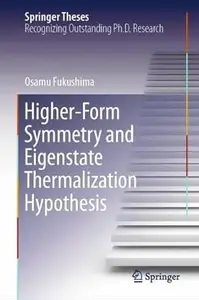
Free Download Higher-Form Symmetry and Eigenstate Thermalization Hypothesis
English | 2025 | ISBN: 9819616425 | 89 Pages | PDF EPUB (True) | 8 MB
The eigenstate thermalization hypothesis (ETH) is a successful framework providing criteria for thermalization in isolated quantum systems. Although numerical and theoretical analyses support the ETH as a fundamental mechanism for explaining thermalization in diverse systems, it remains a challenge to analytically identify whether particular systems satisfy the ETH. In quantum many-body systems and quantum field theories, phenomena that violate the ETH are expected to imply nontrivial thermalization processes, and are gathering increasing attention. This book elucidates how the existence of higher-form symmetries influences the dynamics of thermalization in isolated quantum systems. Under reasonable assumptions, it is analytically shown that a p-form symmetry in a (d+1)-dimensional quantum field theory leads to the breakdown of the ETH for many nontrivial (d-p)-dimensional observables. In the case of discrete higher-form (i.e., p ≥ 1) symmetry, this indicates the absence of thermalization for observables that are non-local but much smaller than the entire system size even though the system do have no local conserved quantities. The author provides numerical evidence for this argument for the (2+1)-dimensional Z2 lattice gauge theory. While local observables such as a plaquette operator thermalize even for mixed symmetry sectors, the non-local observable such as the one exciting a magnetic dipole instead relaxes to the generalized Gibbs ensemble that takes account of the Z2 1-form symmetry. The assumptions of the ETH-violation include the mixing of symmetry sectors within a given energy shell. This condition is rather challenging to verify because it requires information on the eigenstates in the middle of the spectrum. In the subsequent chapter, we further reconsider this assumption from the viewpoint of a projective phase to alleviate this difficulty. In the case of ZN symmetries, the difficulty can be circumvented considering ZNxZN-symmetric theories with a projective phase, and then perturbing the Hamiltonian while preserving one of the ZN symmetries of interest. Additionally, the book also presents numerical analyses for (1+1)-dimensional spin chains and the (2+1)-dimensional Z2 lattice gauge theory to demonstrate this scenario.
Buy Premium From My Links To Get Resumable Support,Max Speed & Support Me
Links are Interchangeable - Single Extraction
Help Us Grow – Share, Support
We need your support to keep providing high-quality content and services. Here’s how you can help:
- Share Our Website on Social Media! 📱
Spread the word by sharing our website on your social media profiles. The more people who know about us, the better we can serve you with even more premium content! - Get a Premium Filehost Account from Website! 🚀
Tired of slow download speeds and waiting times? Upgrade to a Premium Filehost Account for faster downloads and priority access. Your purchase helps us maintain the site and continue providing excellent service.
Thank you for your continued support! Together, we can grow and improve the site for everyone. 🌐
Related News
-
{related-news}
Comments (0)

Information
Users of Guests are not allowed to comment this publication.
Search
Updates
Partner
» TutBB
» Byte
» Crawli
» Warezomen
» Warez-DDL
» Raidrush
» KATZCD
» Free Ebooks Library
Your Link Here ?
(Pagerank 4 or above)
» Byte
» Crawli
» Warezomen
» Warez-DDL
» Raidrush
» KATZCD
» Free Ebooks Library
Your Link Here ?
(Pagerank 4 or above)