



E-Books →The History of Approximation Theory From Euler to Bernstein
Published by: book79 on 7-04-2025, 20:54 |  0
0
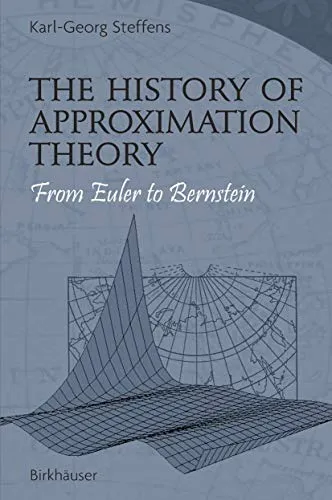
Free Download The History of Approximation Theory: From Euler to Bernstein by Karl-Georg Steffens
English | PDF (True) | 2006 | 235 Pages | ISBN : 0817643532 | 2.1 MB
The problem of approximating a given quantity is one of the oldest challenges faced by mathematicians. Its increasing importance in contemporary mathematics has created an entirely new area known as Approximation Theory. The modern theory was initially developed along two divergent schools of thought: the Eastern or Russian group, employing almost exclusively algebraic methods, was headed by Chebyshev together with his coterie at the Saint Petersburg Mathematical School, while the Western mathematicians, adopting a more analytical approach, included Weierstrass, Hilbert, Klein, and others.
This work traces the history of approximation theory from Leonhard Euler's cartographic investigations at the end of the 18th century to the early 20th century contributions of Sergei Bernstein in defining a new branch of function theory. One of the key strengths of this book is the narrative itself. The author combines a mathematical analysis of the subject with an engaging discussion of the differing philosophical underpinnings in approach as demonstrated by the various mathematicians. This exciting exposition integrates history, philosophy, and mathematics. While demonstrating excellent technical control of the underlying mathematics, the work is focused on essential results for the development of the theory.
The exposition begins with a history of the forerunners of modern approximation theory, i.e., Euler, Laplace, and Fourier. The treatment then shifts to Chebyshev, his overall philosophy of mathematics, and the Saint Petersburg Mathematical School, stressing in particular the roles played by Zolotarev and the Markov brothers. A philosophical dialectic then unfolds, contrasting East vs. West, detailing the work of Weierstrass as well as that of the Goettingen school led by Hilbert and Klein. The final chapter emphasizes the important work of the Russian Jewish mathematician Sergei Bernstein, whose constructive proof of the Weierstrass theorem and extension of Chebyshev's work serve to unify East and West in their approaches to approximation theory.
Appendices containing biographical data on numerous eminent mathematicians, explanations of Russian nomenclature and academic degrees, and an excellent index round out the presentation.
[/b]
Buy Premium From My Links To Get Resumable Support,Max Speed & Support Me
Links are Interchangeable - Single Extraction
Help Us Grow – Share, Support
We need your support to keep providing high-quality content and services. Here’s how you can help:
- Share Our Website on Social Media! 📱
Spread the word by sharing our website on your social media profiles. The more people who know about us, the better we can serve you with even more premium content! - Get a Premium Filehost Account from Website! 🚀
Tired of slow download speeds and waiting times? Upgrade to a Premium Filehost Account for faster downloads and priority access. Your purchase helps us maintain the site and continue providing excellent service.
Thank you for your continued support! Together, we can grow and improve the site for everyone. 🌐
Related News
-
{related-news}
Comments (0)

Information
Users of Guests are not allowed to comment this publication.
Search
Updates
Partner
» TutBB
» Byte
» Crawli
» Warezomen
» Warez-DDL
» Raidrush
» KATZCD
» Free Ebooks Library
Your Link Here ?
(Pagerank 4 or above)
» Byte
» Crawli
» Warezomen
» Warez-DDL
» Raidrush
» KATZCD
» Free Ebooks Library
Your Link Here ?
(Pagerank 4 or above)