



E-Books →The Ancient Mediterranean Trade in Ceramic Building Materials A Case Study in Carthage and Beirut
Published by: book79 on 12-11-2024, 17:02 |  0
0
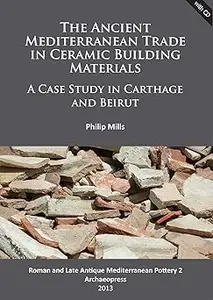
Free Download Philip Mills, "The Ancient Mediterranean Trade in Ceramic Building Materials: A Case Study in Carthage and Beirut "
English | ISBN: 1905739605 | 2013 | 142 pages | PDF | 14 MB
This study (the second volume in the Archaeopress series devoted to the publication of ceramics in the Roman Mediterranean and outlying territories from the late Republic to late Antiquity) addresses the level of interregional trade of ceramic building material (CBM), traditionally seen as a high bulk low value commodity, within the ancient Mediterranean between the third century BC and the seventh century AD. It examines the impact of different modes of production, distribution and consumption of CBM and how archaeological assemblages differ from what is predicted by current models of the ancient economy. It also explores how CBM can be used to investigate cultural identity and urban form. CBM has great potential in investigating these topics. It survives in large quantities in the archaeological record; it is transported as a commodity in its own right, not as a container for other products like amphorae. The amount of CBM used in a building can be estimated, and this can be extrapolated to urban centres to model consumption in ways that are not possible for other goods. This allows the potential derivation of economic information to a higher level of precision than is the case for other materials. The material used in this study derives from stratified assemblages from two major ports of the ancient Mediterranean: Carthage and Beirut. CBM as a material is comparable to pottery, only it does not exhibit the same range of forms. This leaves fabric as a major means of analysing CBM samples. For this reason a programme of petrological thin sectioning has been carried out on these assemblages. These data have been combined with the taphonomic and dating evidence from the excavations. The results showed that the levels of imports of CBM into these two cities were much higher than would normally be expected from the orthodox model of the consumer city. They also suggest that CBM can be used as a tool to investigate cultural identity. This study is the second volume in the Archaeopress series devoted to the publication of ceramics in the Roman Mediterranean and outlying territories from the late Republic to late Antiquity. See below for LRFW 1. Late Roman Fine Wares. Solving problems of typology and chronology. A review of the evidence, debate and new contexts (2012) edited by Miguel Ángel Cau, Paul Reynolds and Michel Bonifay. ISBN 9781905739462.
Read more
Buy Premium From My Links To Get Resumable Support,Max Speed & Support Me
Links are Interchangeable - Single Extraction
Help Us Grow – Share, Support
We need your support to keep providing high-quality content and services. Here’s how you can help:
- Share Our Website on Social Media! 📱
Spread the word by sharing our website on your social media profiles. The more people who know about us, the better we can serve you with even more premium content! - Get a Premium Filehost Account from Website! 🚀
Tired of slow download speeds and waiting times? Upgrade to a Premium Filehost Account for faster downloads and priority access. Your purchase helps us maintain the site and continue providing excellent service.
Thank you for your continued support! Together, we can grow and improve the site for everyone. 🌐
Related News
-
{related-news}
Comments (0)

Information
Users of Guests are not allowed to comment this publication.
Search
Updates
Partner
» TutBB
» Byte
» Crawli
» Warezomen
» Warez-DDL
» Raidrush
» KATZCD
» Free Ebooks Library
Your Link Here ?
(Pagerank 4 or above)
» Byte
» Crawli
» Warezomen
» Warez-DDL
» Raidrush
» KATZCD
» Free Ebooks Library
Your Link Here ?
(Pagerank 4 or above)