



E-Books →Occupied Words What the Holocaust Did to Yiddish
Published by: book79 on 12-11-2024, 15:53 |  0
0
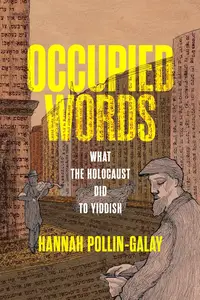
Free Download Occupied Words: What the Holocaust Did to Yiddish (Jewish Culture and Contexts) by Hannah Pollin-Galay
English | September 3, 2024 | ISBN: 1512825905 | True EPUB | 312 pages | 14.2 MB
How Yiddish changed to express and memorialize the trauma of the Holocaust
The Holocaust radically altered the way many East European Jews spoke Yiddish. Finding prewar language incapable of describing the imprisonment, death, and dehumanization of the Shoah, prisoners added or reinvented thousands of Yiddish words and phrases to describe their new reality. These crass, witty, and sometimes beautiful Yiddish words - Khurbn Yiddish, or "Yiddish of the Holocaust" - puzzled and intrigued the East European Jews who were experiencing the metamorphosis of their own tongue in real time. Sensing that Khurbn Yiddish words harbored profound truths about what Jews endured during the Holocaust, some Yiddish speakers threw themselves into compiling dictionaries and glossaries to document and analyze these new words. Others incorporated Khurbn Yiddish into their poetry and prose. In Occupied Words, Hannah Pollin-Galay explores Khurbn Yiddish as a form of Holocaust memory and as a testament to the sensation of speech under genocidal conditions.
Occupied Words investigates Khurbn Yiddish through the lenses of cultural history, philology, and literary interpretation. Analyzing fragments of language consciousness left behind from the camps and ghettos alongside the postwar journeys of three intellectuals―Nachman Blumental, Israel Kaplan and Elye Spivak―Pollin-Galay seeks to understand why people chose Yiddish lexicography as a means of witnessing the Holocaust. She then turns to the Khurbn Yiddish words themselves, focusing on terms related to theft, the German-Yiddish encounter and the erotic female body. Here, the author unearths new perspectives on how Jews experienced daily life under Nazi occupation, while raising questions about language and victimhood. Lastly, the book explores how writers turned ghetto and camp slang into art―highlighting the poetry and fiction of K. Tzetnik (Yehiel Di-Nur) and Chava Rosenfarb. Ultimately, Occupied Words speaks to broader debates about cultural genocide, asking how we might rethink the concept of genocide through the framework of language.
Buy Premium From My Links To Get Resumable Support,Max Speed & Support Me
Links are Interchangeable - Single Extraction
Help Us Grow – Share, Support
We need your support to keep providing high-quality content and services. Here’s how you can help:
- Share Our Website on Social Media! 📱
Spread the word by sharing our website on your social media profiles. The more people who know about us, the better we can serve you with even more premium content! - Get a Premium Filehost Account from Website! 🚀
Tired of slow download speeds and waiting times? Upgrade to a Premium Filehost Account for faster downloads and priority access. Your purchase helps us maintain the site and continue providing excellent service.
Thank you for your continued support! Together, we can grow and improve the site for everyone. 🌐
Related News
-
{related-news}
Comments (0)

Information
Users of Guests are not allowed to comment this publication.
Search
Updates
Partner
» TutBB
» Byte
» Crawli
» Warezomen
» Warez-DDL
» Raidrush
» KATZCD
» Free Ebooks Library
Your Link Here ?
(Pagerank 4 or above)
» Byte
» Crawli
» Warezomen
» Warez-DDL
» Raidrush
» KATZCD
» Free Ebooks Library
Your Link Here ?
(Pagerank 4 or above)