



E-Books →Archaeological Data Recovery in the Piceance and Wyoming Basins of Northwestern Colorado and Southwestern Wyoming
Published by: book79 on 12-11-2024, 12:24 |  0
0
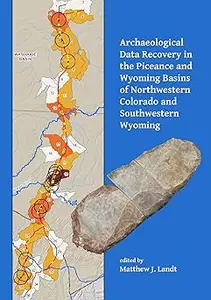
Free Download Matthew J. Landt, "Archaeological Data Recovery in the Piceance and Wyoming Basins of Northwestern Colorado and Southwestern Wyoming"
English | ISBN: 1784917958 | 2018 | 378 pages | PDF | 42 MB
In the United States of America, Section 106 of the National Historic Preservation Act requires that projects funded, authorized, or permitted by the federal government consider historic properties that may be affected by the development of those projects. To comply with Section 106, an interstate pipeline corridor in southwestern Wyoming and northwestern Colorado was surveyed to identify cultural resources and to evaluate them in terms of significance and potential listing in the National Register of Historic Places. Once sites were identified, a mitigation strategy was developed in coordination with the Bureau of Land Management. That plan prioritized important cultural resources within a regional archaeological context and included substantial excavations at 14 sites. The archaeological excavations were successful in recovering the types of data necessary to address regional research issues that were raised in the project's alternative mitigation plan. The data recovery effort included site-specific geophysical assessments as well as providing an opportunity to analyze the geology, fauna, flora, and tens of thousands of prehistoric and historical artifacts from the sites. While there is nothing about the number of artifacts that inherently adds to our understandings of past lifeways, the analyses substantially added to regional datasets for the Paleoindian, Archaic, Formative, Protohistoric, and Historical components. Specifically, the analyses addressed prehistoric chronometric and settlement patterns (Chapter 5), subsistence strategies (Chapter 6), lithic reduction strategies (Chapter 7), as well as synthesizing information for prehistoric hearths (Chapter 8) and architecture (Chapter 9). Chapter 10 focuses on the results of remote sensing at two sites. That is followed by regional syntheses of the prehistoric (Chapter 11) and historical data (Chapter 12). When combined with existing datasets, this synthetic work substantially improves the quality of regional archaeological interpretations. Given the results presented herein, it is clear that the mitigation approach within the pipeline corridor was successful in providing important archaeological information that advances local and regional understandings of past lifeways.
Read more
Buy Premium From My Links To Get Resumable Support,Max Speed & Support Me
Links are Interchangeable - Single Extraction
Help Us Grow – Share, Support
We need your support to keep providing high-quality content and services. Here’s how you can help:
- Share Our Website on Social Media! 📱
Spread the word by sharing our website on your social media profiles. The more people who know about us, the better we can serve you with even more premium content! - Get a Premium Filehost Account from Website! 🚀
Tired of slow download speeds and waiting times? Upgrade to a Premium Filehost Account for faster downloads and priority access. Your purchase helps us maintain the site and continue providing excellent service.
Thank you for your continued support! Together, we can grow and improve the site for everyone. 🌐
Related News
-
{related-news}
Comments (0)

Information
Users of Guests are not allowed to comment this publication.
Search
Updates
Partner
» TutBB
» Byte
» Crawli
» Warezomen
» Warez-DDL
» Raidrush
» KATZCD
» Free Ebooks Library
Your Link Here ?
(Pagerank 4 or above)
» Byte
» Crawli
» Warezomen
» Warez-DDL
» Raidrush
» KATZCD
» Free Ebooks Library
Your Link Here ?
(Pagerank 4 or above)