



E-Books →Guaranteed Computational Methods for Self–Adjoint Differential Eigenvalue Problems
Published by: book79 on 10-09-2024, 01:38 |  0
0
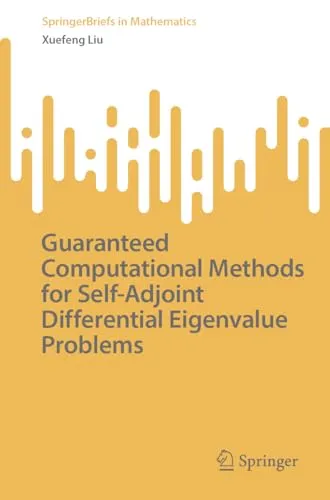
Free Download Guaranteed Computational Methods for Self-Adjoint Differential Eigenvalue Problems by Xuefeng Liu
English | PDF EPUB (True) | 2024 | 139 Pages | ISBN : 9819735769 | 14 MB
This monograph presents a study of newly developed guaranteed computational methodologies for eigenvalue problems of self-adjoint differential operators. It focuses on deriving explicit lower and upper bounds for eigenvalues, as well as explicit estimations for eigenfunction approximations. Such explicit error estimations rely on the finite element method (FEM) along with a new theory of explicit quantitative error estimation, diverging from traditional studies that primarily focus on qualitative results.
To achieve quantitative error estimation, the monograph begins with an extensive analysis of the hypercircle method, that is, the Prager-Synge theorem. It introduces a novel a priori error estimation technique based on the hypercircle method. This facilitates the explicit estimation of Galerkin projection errors for equations such as Poisson's and Stokes', which are crucial for obtaining lower eigenvalue bounds via conforming FEMs.
A thorough exploration of the fundamental theory of projection-based explicit lower eigenvalue bounds under a general setting of eigenvalue problems is also offered. This theory is extensively detailed when applied to model eigenvalue problems associated with the Laplace, biharmonic, Stokes, and Steklov differential operators, which are solved by either conforming or non-conforming FEMs.
Moreover, there is a detailed discussion on the Lehmann-Goerisch theorem for the purpose of high-precision eigenvalue bounds, showing its relationship with previously established theorems, such as Lehmann-Maehly's method and Kato's bound. The implementation details of this theorem with FEMs, a topic rarely covered in existing literature, are also clarified.
Lastly, the monograph introduces three new algorithms to estimate eigenfunction approximation errors, revealing the potency of classical theorems. Algorithm I extends Birkhoff's result that works for simple eigenvalues to handle clustered eigenvalues, while Algorithm II generalizes the Davis-Kahan theorem, initially designed for strongly formulated eigenvalue problems, to address weakly formulated eigenvalue problems. Algorithm III utilizes the explicit Galerkin projection error estimation to efficiently handle Galerkin projection-based approximations.
[/b]
Buy Premium From My Links To Get Resumable Support,Max Speed & Support Me
Links are Interchangeable - Single Extraction
Help Us Grow – Share, Support
We need your support to keep providing high-quality content and services. Here’s how you can help:
- Share Our Website on Social Media! 📱
Spread the word by sharing our website on your social media profiles. The more people who know about us, the better we can serve you with even more premium content! - Get a Premium Filehost Account from Website! 🚀
Tired of slow download speeds and waiting times? Upgrade to a Premium Filehost Account for faster downloads and priority access. Your purchase helps us maintain the site and continue providing excellent service.
Thank you for your continued support! Together, we can grow and improve the site for everyone. 🌐
Related News
-
{related-news}
Comments (0)

Information
Users of Guests are not allowed to comment this publication.
Search
Updates
Partner
» TutBB
» Byte
» Crawli
» Warezomen
» Warez-DDL
» Raidrush
» KATZCD
» Free Ebooks Library
Your Link Here ?
(Pagerank 4 or above)
» Byte
» Crawli
» Warezomen
» Warez-DDL
» Raidrush
» KATZCD
» Free Ebooks Library
Your Link Here ?
(Pagerank 4 or above)