



E-Books →MRI of Short and Ultrashort–T 2 Tissues Making the Invisible Visible
Published by: book79 on 13-03-2024, 09:26 |  0
0
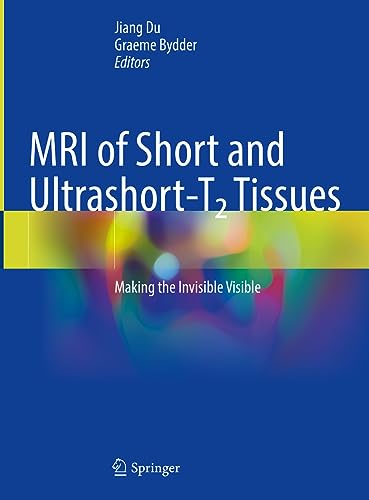
Free Download MRI of Short and Ultrashort-T_2 Tissues: Making the Invisible Visible by Jiang Du, Graeme M. Bydder
English | PDF (True) | 2024 | 612 Pages | ISBN : 3031351967 | 67.9 MB
This book comprehensively covers ultrashort echo time (UTE), zero echo time (ZTE), and other magnetic resonance imaging (MRI) acquisition techniques for imaging of short and ultrashort-T2 tissues. MRI uses a large magnet and radio waves to generate images of tissues in the body. The MRI signal is characterized by two time constants, spin-lattice relaxation time (T1) which describes how fast the longitudinal magnetization recovers to its initial value after tipping to the transverse plane, and spin-spin relaxation time (T2) which describes how fast the transverse magnetization decays. Conventional MRI techniques have been developed to image and quantify tissues with relatively long T2s.
However, the body also contains many tissues and tissue components such as cortical bone, menisci, ligaments, tendons, the osteochondral junction, calcified tissues, lung parenchyma, iron containing tissues, and myelin, which have short or ultrashort-T2s. These tissues are "invisible" with conventional MRI, and their MR and tissue properties are not measurable. UTE and ZTE type sequences resolve these challenges and make these tissues visible and quantifiable.
This book first introduces the basic physics of conventional MRI as well as UTE and ZTE type MRI, including radiofrequency excitation, data acquisition, and image reconstruction. A series of contrast mechanisms are then introduced and these provide high resolution, high contrast imaging of short and ultrashort-T2 tissues. A series of quantitative UTE imaging techniques are described for measurement of MR tissue properties (proton density, T1, T2, T2*, T1p,magnetization transfer, susceptibility, perfusion and diffusion). Finally, clinical applications in the musculoskeletal, neurological, pulmonary and cardiovascular systems are described.
This is an ideal guide for physicists and radiologists interested in learning more about the use of UTE and ZTE type techniques for MRI of short and ultrashort-T2 tissues.
[b]Buy Premium From My Links To Get Resumable Support,Max Speed & Support Me
Links are Interchangeable - Single Extraction
Help Us Grow – Share, Support
We need your support to keep providing high-quality content and services. Here’s how you can help:
- Share Our Website on Social Media! 📱
Spread the word by sharing our website on your social media profiles. The more people who know about us, the better we can serve you with even more premium content! - Get a Premium Filehost Account from Website! 🚀
Tired of slow download speeds and waiting times? Upgrade to a Premium Filehost Account for faster downloads and priority access. Your purchase helps us maintain the site and continue providing excellent service.
Thank you for your continued support! Together, we can grow and improve the site for everyone. 🌐
Related News
-
{related-news}
Comments (0)

Information
Users of Guests are not allowed to comment this publication.
Search
Updates
Partner
» TutBB
» Byte
» Crawli
» Warezomen
» Warez-DDL
» Raidrush
» KATZCD
» Free Ebooks Library
Your Link Here ?
(Pagerank 4 or above)
» Byte
» Crawli
» Warezomen
» Warez-DDL
» Raidrush
» KATZCD
» Free Ebooks Library
Your Link Here ?
(Pagerank 4 or above)