



E-Books →Actors in the Audience. Theatricality and Doublespeak from Nero to Hadrian
Published by: book79 on 10-01-2024, 10:48 |  0
0
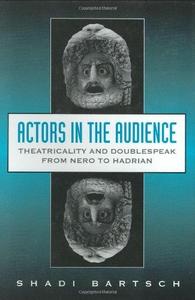
Free Download Actors in the Audience. Theatricality and Doublespeak from Nero to Hadrian By Bartsch, Shadi
1998 | 320 Pages | ISBN: 0674003578 | PDF | 5 MB
When Nero took the stage, the audience played along - or else. The drama thus enacted, whether in the theatre proper or in the political arena, unfolds in all its complexity in "Actors in the Audience". This is a book about language, theatricality and empire - about how the Roman emperor dramatized his rule and how his subordinates in turn staged their response. The focus is on...When Nero took the stage, the audience played along - or else. The drama thus enacted, whether in the theatre proper or in the political arena, unfolds in all its complexity in "Actors in the Audience". This is a book about language, theatricality and empire - about how the Roman emperor dramatized his rule and how his subordinates in turn staged their response. The focus is on Nero: his performances onstage spurred his contemporaries to reflect on the nature of power and representation, and to make the stage a paradigm for larger questions about the theatricality of power. Through these portrayals by ancient writers, Shadi Bartsch explores what happens to language and representation when all discourse is distorted by the pull of an autocratic authority. Some Roman senators, forced to become actors and dissimulators under the scrutinizing eye of the ruler, portrayed themselves and their class as the victims of regimes that are, to the modern eye, redolent of Stalinism. Other writers claimed that doublespeak - saying one thing and meaning two - was the way one could, and did, undo the constraining effects of imperial oppression. Tacitus, Suetonius, and Juvenal all figure in Bartsch's shrewd analysis of historical and literary responses to the brute facts of empire; even the "Panegyricus" of Pliny the Younger now appears as a reaction against the widespread awareness of dissimulation. Informed by theories of dramaturgy, sociology, new historicism and cultural criticism, this close reading of literary and historical texts gives us a new perspective on the politics of the Roman Empire, and on the languages and representation of power.
Buy Premium From My Links To Get Resumable Support,Max Speed & Support Me
Links are Interchangeable - Single Extraction
Help Us Grow – Share, Support
We need your support to keep providing high-quality content and services. Here’s how you can help:
- Share Our Website on Social Media! 📱
Spread the word by sharing our website on your social media profiles. The more people who know about us, the better we can serve you with even more premium content! - Get a Premium Filehost Account from Website! 🚀
Tired of slow download speeds and waiting times? Upgrade to a Premium Filehost Account for faster downloads and priority access. Your purchase helps us maintain the site and continue providing excellent service.
Thank you for your continued support! Together, we can grow and improve the site for everyone. 🌐
Related News
-
{related-news}
Comments (0)

Information
Users of Guests are not allowed to comment this publication.
Search
Updates
Partner
» TutBB
» Byte
» Crawli
» Warezomen
» Warez-DDL
» Raidrush
» KATZCD
» Free Ebooks Library
Your Link Here ?
(Pagerank 4 or above)
» Byte
» Crawli
» Warezomen
» Warez-DDL
» Raidrush
» KATZCD
» Free Ebooks Library
Your Link Here ?
(Pagerank 4 or above)