



E-Books →The Other Side of the Coin The Comparative Evidence of Cash and in–Kind Transfers in Humanitarian Situations
Published by: book79 on 26-12-2023, 01:28 |  0
0
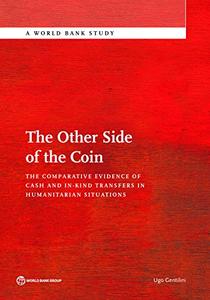
Free Download The Other Side of the Coin: The Comparative Evidence of Cash and in-Kind Transfers in Humanitarian Situations? (World Bank) by Ugo Gentilini
English | September 12, 2016 | ISBN: 1464809100 | 66 pages | EPUB | 2.77 Mb
Over 60 million people are currently displaced due to conflict or violence, and about 140 million are exposed to natural disasters. As part of humanitarian responses to those affected populations, growing attention is paid to cash transfers as a form of assistance. Cash is being strongly advocated by several actors, and for good reasons: they have the potential to provide choice, empower people, and spark economic multipliers. But what is their comparative performance relative to in-kind transfers? Are there objectives for which there are particular evidence gaps? And what should be considered when choosing between those forms of assistance?
This paper is one of the first reviews examining those questions across humanitarian sectors and in relation to multiple forms of assistance, including cash, vouchers, and in-kind assistance (food and non-food). These were assessed based on solid impact evaluations and through the lens of food security, nutrition, livelihoods, health, education, and shelter objectives.
The paper finds that there is large variance in the availability of comparative evidence across sectors. This ranges from areas where evidence is substantial (i.e., food security) to realms where it is limited (i.e., nutrition) or where not a single comparative evaluation was available (i.e., health, education, and shelter). Where evidence is substantial, data shows that the effectiveness of cash and in-kind transfers is similar on average. In terms of costs, cash is generally more efficient to delivery. However, overall costs would hinge on the scale of interventions, crisis context, procurement practices, and a range of 'hidden costs'.
In other words, the appropriateness of transfers cannot be predetermined and should emerge from response analysis that considers program objectives, the level of market functionality, predicted cost-effectiveness, implementation capacity, the management of key risks such as on protection and gender, political economy, beneficiary preferences, and resource availability. Finally, it seems possible (and necessary) to reconcile humanitarian imperatives with solid research to inform decision-making, especially on dimensions beyond food security.
Buy Premium From My Links To Get Resumable Support,Max Speed & Support Me
Links are Interchangeable - Single Extraction
Help Us Grow – Share, Support
We need your support to keep providing high-quality content and services. Here’s how you can help:
- Share Our Website on Social Media! 📱
Spread the word by sharing our website on your social media profiles. The more people who know about us, the better we can serve you with even more premium content! - Get a Premium Filehost Account from Website! 🚀
Tired of slow download speeds and waiting times? Upgrade to a Premium Filehost Account for faster downloads and priority access. Your purchase helps us maintain the site and continue providing excellent service.
Thank you for your continued support! Together, we can grow and improve the site for everyone. 🌐
Related News
-
{related-news}
Comments (0)

Information
Users of Guests are not allowed to comment this publication.
Search
Updates
Partner
» TutBB
» Byte
» Crawli
» Warezomen
» Warez-DDL
» Raidrush
» KATZCD
» Free Ebooks Library
Your Link Here ?
(Pagerank 4 or above)
» Byte
» Crawli
» Warezomen
» Warez-DDL
» Raidrush
» KATZCD
» Free Ebooks Library
Your Link Here ?
(Pagerank 4 or above)