



E-Books →Extending the Theory of Composites to Other Areas of Science
Published by: book79 on 11-07-2023, 00:37 |  0
0
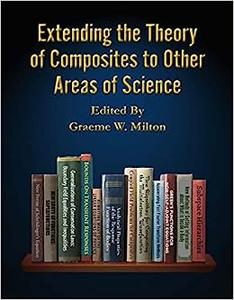
Free Download Graeme Walter Milton, Maxence Cassier, Ornella Mattei, "Extending the Theory of Composites to Other Areas of Science"
English | 2016 | pages: 444 | ISBN: 1483569195 | PDF | 6,2 mb
In Chapter 1 we review many of the linear equations of physics, and write them in a canonical form appropriate to the theory of composites. We show how conservation laws, which have played a key role throughout the history of science, can be generalized to equalities which we call "boundary field equalities and inequalities". Chapter 2 reviews the abstract theory of composites, both for the effective tensor and for the associated "Y -tensor". Chapter 3 shows that the problem of finding the Dirichlet-to-Neumann map which governs the response of inhomogeneous bodies, for acoustics, elastodynamics, or electromagnetism can be reformulated as the problem of finding the effective tensor (operator) associated with an abstract problem in the theory of composites. Thus, many tools for bounding effective tensors extend to bounding the Dirichlet-to-Neumann map. Chapter 4, with Maxence Cassier and Aaron Welters, studies in depth the analyticity properties of the Dirichlet-to-Neumann map for electromagnetism, as functions of the variables representing the permittivities and permeabilities of the phases multiplied by the frequency. It is established that the map is an operator-valued Herglotz function of these complex variables. It is anticipated that this will be useful for establishing fundamental limits on performances of devices. Chapter 5 explores bounds on the Dirichlet-to-Neumann map and the associated inverse problem of what can be said about the distribution of materials inside a body from surface measurements, using the connection between Dirichlet-to-Neumann maps and effective tensors in composites. Chapter 6, with Ornella Mattei, derives bounds on the transient response of viscoelastic composites. Significantly, we found that the volume fractions of the phases could almost be exactly determined from measurements of the transient response at certain times. Chapter 7 develops the algebra of finite-dimensional subspace collections. By relaxing the requirement that the subspaces are orthogonal we find that there is a rich algebraic structure associated with subspace collections: operations of addition, subtraction, multiplication, division and substitution can all be defined. Some of these operations are analogous to operations one can do with resistor networks. In Chapter 8 we show this algebra has important uses: in particular by substituting a collection with non- orthogonal subspaces in one with orthogonal subspaces we can accelerate Fast Fourier transform methods for computing the effective tensor and fields in periodic conducting composites, as demonstrated by the numerical results of Moulinec and Suquet. Chapter 9, with Moti Milgrom, looks at the response of multiphase bodies and composites to different fields, which may be electric fields, magnetic fields, temperature gradients, or concentration gradients, which interact in the components due to coupling terms. Chapter 10, with Maxence Cassier and Aaron Welters, develops a rigorous basis for the field equation recursion method for composites of two isotropic phases. This uses a stratification of the Hilbert space, and an inductive procedure, to link together a sequence of associated effective tensors. Chapter 11 shows that by minimising the integral of the square of the Schrodinger equation one can develop a "density functional theory" for excited states in multielectron systems, called "Projection functional theory". Chapter 12 shows one can desymmetrize the Schrödinger equation and develop iterative FFT methods for solving it which at each step only require Fourier transforms in the coordinates of just two electrons. Chapter 13 develops minimization variational principles for Schrodinger's equation for excited states when the energy is complex, and explores certain quadratic functions which have properties that could be useful in analysis. Chapter 14 shows how one can obtain Green's functions for problems with non-self-adjoint operators.
Buy Premium From My Links To Get Resumable Support,Max Speed & Support Me
Links are Interchangeable - Single Extraction
Help Us Grow – Share, Support
We need your support to keep providing high-quality content and services. Here’s how you can help:
- Share Our Website on Social Media! 📱
Spread the word by sharing our website on your social media profiles. The more people who know about us, the better we can serve you with even more premium content! - Get a Premium Filehost Account from Website! 🚀
Tired of slow download speeds and waiting times? Upgrade to a Premium Filehost Account for faster downloads and priority access. Your purchase helps us maintain the site and continue providing excellent service.
Thank you for your continued support! Together, we can grow and improve the site for everyone. 🌐
Related News
-
{related-news}
Comments (0)

Information
Users of Guests are not allowed to comment this publication.
Search
Updates
Partner
» TutBB
» Byte
» Crawli
» Warezomen
» Warez-DDL
» Raidrush
» KATZCD
» Free Ebooks Library
Your Link Here ?
(Pagerank 4 or above)
» Byte
» Crawli
» Warezomen
» Warez-DDL
» Raidrush
» KATZCD
» Free Ebooks Library
Your Link Here ?
(Pagerank 4 or above)