



E-Books →Stochastic Processes
Published by: book24h on 5-04-2023, 14:31 |  0
0
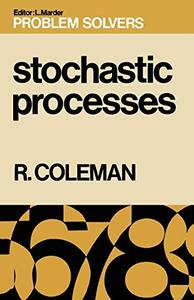
Free Download Stochastic Processes by Rodney Coleman
English | PDF | 1974 | 99 Pages | ISBN : 0045190178 | 5.95 MB
The word stochastic is jargon for random. A stochastic process is a system which evolves in time while undergoing chance fluctuations. We can describe such a system by defining a family of random variables, {Xt}' where Xt measures, at time t, the aspect of the system which is of interest. For example, X t might be the number of customers in a queue at time t. As time passes, customers will arrive and leave, and so the value of Xt will change. At any time t, Xt takes one of the values 0, 1,2, ... ; and t can be any value in a subset of ( - 00, 00), the infinite past to the infinite future. If we observe the queue continuously, and customers arrive one at a time to be served by a single server, then, when a customer arrives, the value of Xt' the queue size, increases by one, and when a customer departs after being served, X t decreases by one (Figure 1.1).
The word stochastic is jargon for random. A stochastic process is a system which evolves in time while undergoing chance fluctuations. We can describe such a system by defining a family of random variables, {Xt}' where Xt measures, at time t, the aspect of the system which is of interest. For example, X t might be the number of customers in a queue at time t. As time passes, customers will arrive and leave, and so the value of Xt will change. At any time t, Xt takes one of the values 0, 1,2, ... ; and t can be any value in a subset of ( - 00, 00), the infinite past to the infinite future. If we observe the queue continuously, and customers arrive one at a time to be served by a single server, then, when a customer arrives, the value of Xt' the queue size, increases by one, and when a customer departs after being served, X t decreases by one (Figure 1.1). The values which Xt can take are called its states, and changes in the value of Xt are called transitions between its states. If we observe the queue size not continuously but at unit intervals, say once every quarter of an hour, then more than one customer can arrive or leave in each time interval. This will lead to larger fluctuations in the value of XI' These obvious statements represent the basis of the construction of a model of a queue which incorporates random intervals between the arrivals of customers and random periods spent at the service point. It is the often complex consequences of these idealised models which we shall be studying. Simple as these models are, by incorporating a little of the randomness of the real world they bring us far closer to understanding the real world than could possibly be achieved with models which neglect such random behaviour.

Links are Interchangeable - Single Extraction
Help Us Grow – Share, Support
We need your support to keep providing high-quality content and services. Here’s how you can help:
- Share Our Website on Social Media! 📱
Spread the word by sharing our website on your social media profiles. The more people who know about us, the better we can serve you with even more premium content! - Get a Premium Filehost Account from Website! 🚀
Tired of slow download speeds and waiting times? Upgrade to a Premium Filehost Account for faster downloads and priority access. Your purchase helps us maintain the site and continue providing excellent service.
Thank you for your continued support! Together, we can grow and improve the site for everyone. 🌐
Related News
-
{related-news}
Comments (0)

Information
Users of Guests are not allowed to comment this publication.
Search
Updates
Partner
» TutBB
» Byte
» Crawli
» Warezomen
» Warez-DDL
» Raidrush
» KATZCD
» Free Ebooks Library
Your Link Here ?
(Pagerank 4 or above)
» Byte
» Crawli
» Warezomen
» Warez-DDL
» Raidrush
» KATZCD
» Free Ebooks Library
Your Link Here ?
(Pagerank 4 or above)