



E-Books →On the Genesis of Thought and Language
Published by: book24h on 5-02-2023, 09:23 |  0
0
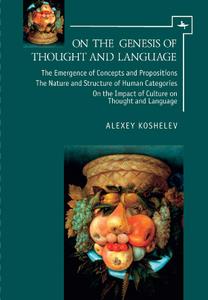
On the Genesis of Thought and Language : On the Emergence of Concepts and Propositions The Nature and Structure of Human Categories On the Impact of Culture on Thought and Language
by Alexey Koshelev
English | 2020 | ISBN: 1644693143 | 237 Pages | True PDF | 3.87 MB
In On the Genesis of Thought and Language, linguist Alexey Koshelev explores fundamental questions of how human concepts arise in a child, why concepts appear in a child before words, the genesis of language, and why there are so many languages. Chapter One introduces the fundamental dichotomy "visual (exogenous) vs. functional (endogenous)" cognitive units; these units are used to give non-verbal definitions of mental representations of various objects, actions, and situations. In particular, definitions of such concepts as GLASS, CHAIR, BANANA, TREE, LAKE, RUN, and some others are given. Chapter Two discusses how children form concepts, hierarchical relationships, and propositions (conceptual 'utterances'). It is shown that the initial units of the child's representation of the world are pre-conceptual cognitive units―mental representations of whole situations. In the course of two consecutive cycles in the child's cognitive development, these units transform into (a) primary notions―object and motor concepts, and (b) binary role relationships. Together, they constitute the elementary language of thought which, in the process of thinking, is used to build conceptual structures―propositions. It is further demonstrated that, immediately after the formation of thought, the child begins to develop his native language in which concrete and motor concepts become initial meanings of nouns and verbs, while propositions become the meanings of the child's expressions. The chapter concludes with a contrastive analysis of the proposed approach and Aristotle's and Chomsky's views on thought and language. Chapter Three analyzes how a community's culture affects its language. It is demonstrated that the progress of a community, the main constituent of the civilizational component of its culture, enhances the development of the content component of language by extending the range of its lexical and grammatical meanings. In the context of this analysis, Daniel Everett's (2008) hypothesis that culture affects language structure is discussed. In the subsequent sections, models of the development of human and social activity are offered. These models comprise three components: Activity (main component), Thought, and Language (auxiliary components that ensure the successful realization of activities). The models are illustrated with examples of some concrete societies.

Fikper
uvund.O.t.G.o.T.a.L.rar.html
Rapidgator
uvund.O.t.G.o.T.a.L.rar.html
NitroFlare
uvund.O.t.G.o.T.a.L.rar
Uploadgig
uvund.O.t.G.o.T.a.L.rar
Please Help Me Click Connect Icon Below Here and Share News to Social Network | Thanks you !
Help Us Grow – Share, Support
We need your support to keep providing high-quality content and services. Here’s how you can help:
- Share Our Website on Social Media! 📱
Spread the word by sharing our website on your social media profiles. The more people who know about us, the better we can serve you with even more premium content! - Get a Premium Filehost Account from Website! 🚀
Tired of slow download speeds and waiting times? Upgrade to a Premium Filehost Account for faster downloads and priority access. Your purchase helps us maintain the site and continue providing excellent service.
Thank you for your continued support! Together, we can grow and improve the site for everyone. 🌐
Related News
-
{related-news}
Comments (0)

Information
Users of Guests are not allowed to comment this publication.
Search
Updates
Partner
» TutBB
» Byte
» Crawli
» Warezomen
» Warez-DDL
» Raidrush
» KATZCD
» Free Ebooks Library
Your Link Here ?
(Pagerank 4 or above)
» Byte
» Crawli
» Warezomen
» Warez-DDL
» Raidrush
» KATZCD
» Free Ebooks Library
Your Link Here ?
(Pagerank 4 or above)