



E-Books →Finite Element Method Simulation of 3D Deformable Solids
Published by: book24h on 7-01-2023, 18:23 |  0
0
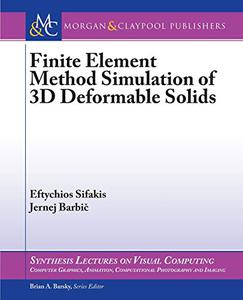
Finite Element Method Simulation of 3D Deformable Solids by Eftychios Sifakis
English | PDF(True) | 2016 | 71 Pages | ISBN : 1627054421 | 1 MB
This book serves as a practical guide to simulation of 3D deformable solids using the Finite Element Method (FEM). It reviews a number of topics related to the theory and implementation of FEM approaches: measures of deformation, constitutive laws of nonlinear materials, tetrahedral discretizations, and model reduction techniques for real-time simulation.
This book serves as a practical guide to simulation of 3D deformable solids using the Finite Element Method (FEM). It reviews a number of topics related to the theory and implementation of FEM approaches: measures of deformation, constitutive laws of nonlinear materials, tetrahedral discretizations, and model reduction techniques for real-time simulation.
Simulations of deformable solids are important in many applications in computer graphics, including film special effects, computer games, and virtual surgery. The Finite Element Method has become a popular tool in many such applications. Variants of FEM catering to both offline and real-time simulation have had a mature presence in computer graphics literature. This book is designed for readers familiar with numerical simulation in computer graphics, who would like to obtain a cohesive picture of the various FEM simulation methods available, their strengths and weaknesses, and their applicability in various simulation scenarios. The book is also a practical implementation guide for the visual effects developer, offering a lean yet adequate synopsis of the underlying mathematical theory.
Chapter 1 introduces the quantitative descriptions used to capture the deformation of elastic solids, the concept of strain energy, and discusses how force and stress result as a response to deformation. Chapter 2 reviews a number of constitutive models, i.e., analytical laws linking deformation to the resulting force that has successfully been used in various graphics-oriented simulation tasks. Chapter 3 summarizes how deformation and force can be computed discretely on a tetrahedral mesh, and how an implicit integrator can be structured around this discretization. Finally, chapter 4 presents the state of the art in model reduction techniques for real-time FEM solid simulation and discusses which techniques are suitable for which applications. Topics discussed in this chapter include linear modal analysis, modal warping, subspace simulation, and domain decomposition.

Download From 1DL
https://1dl.net/bmd2ulj17xl5/zprpf.F.E.M.S.o.3.D.S.rar
![]()
https://rapidgator.net/file/5c8e759d21e5c431450e1a24632e6af0/zprpf.F.E.M.S.o.3.D.S.rar.html
![]()
https://nitroflare.com/view/A421AB6BA51E6E4/zprpf.F.E.M.S.o.3.D.S.rar
![]()
https://uploadgig.com/file/download/Cb12415a01f44dB6/zprpf.F.E.M.S.o.3.D.S.rar
https://1dl.net/bmd2ulj17xl5/zprpf.F.E.M.S.o.3.D.S.rar

https://rapidgator.net/file/5c8e759d21e5c431450e1a24632e6af0/zprpf.F.E.M.S.o.3.D.S.rar.html

https://nitroflare.com/view/A421AB6BA51E6E4/zprpf.F.E.M.S.o.3.D.S.rar

https://uploadgig.com/file/download/Cb12415a01f44dB6/zprpf.F.E.M.S.o.3.D.S.rar
Please Help Me Click Connect Icon Below Here and Share News to Social Network | Thanks you !
Help Us Grow – Share, Support
We need your support to keep providing high-quality content and services. Here’s how you can help:
- Share Our Website on Social Media! 📱
Spread the word by sharing our website on your social media profiles. The more people who know about us, the better we can serve you with even more premium content! - Get a Premium Filehost Account from Website! 🚀
Tired of slow download speeds and waiting times? Upgrade to a Premium Filehost Account for faster downloads and priority access. Your purchase helps us maintain the site and continue providing excellent service.
Thank you for your continued support! Together, we can grow and improve the site for everyone. 🌐
Related News
-
{related-news}
Comments (0)

Information
Users of Guests are not allowed to comment this publication.
Search
Updates
Partner
» TutBB
» Byte
» Crawli
» Warezomen
» Warez-DDL
» Raidrush
» KATZCD
» Free Ebooks Library
Your Link Here ?
(Pagerank 4 or above)
» Byte
» Crawli
» Warezomen
» Warez-DDL
» Raidrush
» KATZCD
» Free Ebooks Library
Your Link Here ?
(Pagerank 4 or above)