



E-Books →Modern Chinese Parts of Speech Classification Theory
Published by: book24h on 1-01-2023, 22:53 |  0
0
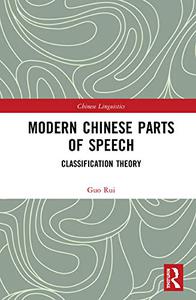
Guo Rui, "Modern Chinese Parts of Speech: Classification Theory"
English | 2019 | ISBN: 1138576719, Religion | PDF | pages: 224 | 6.6 mb
What is the essence of a part of speech? Why is it difficult to classify parts of speech? What are the bases and criteria for classifying them? How should they be classified? In doing so, how should a conversional word be dealt with? How should nomonalization be treated? These are just some of the questions answered in this book.
The classification of parts of speech in Chinese is a tough job due to the language's lack of morphological differences. Based on the analysis of nearly 40,000 Chinese characters, this book proposes that, essentially, a part of speech is not of distributional type and that its intrinsic basis is an expressional function and the semantic type. Essentially, large categories such as substantive words, predicate words and modification words are classes of words classified according to their expressional functions. Basic categories such as nouns, verbs and adjectives are classes that combine semantic types with syntactical functions. In classifying parts of speech, the book pays attention not to identifying a single distributive characteristic that is internally universal and externally exclusive but to clustering the grammatical functions that have the same classification value through the "reflection-representation" relationship among distribution, expressional function and semantic type (distribution reflects expressional function and semantic type, which are, in turn, represented as distribution), thereby identifying the classification criteria. It uses distributional compatibility and the correlation principle to analyze which distributional differences represent differences in parts of speech and which do not. In this way, grammatical functions that have equal classification values are collected into one equivalent function cluster, each of which represents one part of speech. The book uses four strategies to classify parts of speech, namely the homogeneity strategy, the homomorphical strategy, the priority homomorphical strategy and the consolidation strategy. It will be a valuable reference for Chinese linguistic researchers and students as well as Chinese learners.

Download From 1DL
https://1dl.net/wuxgldi8qen4/mome8.M.C.P.o.S.C.T.rar
![]()
https://rapidgator.net/file/2c318e8852379e2e11f2dab1a60b8e73/mome8.M.C.P.o.S.C.T.rar.html
![]()
https://nitroflare.com/view/CA374940148017C/mome8.M.C.P.o.S.C.T.rar
![]()
https://uploadgig.com/file/download/582eC38d2bb9a0B0/mome8.M.C.P.o.S.C.T.rar
https://1dl.net/wuxgldi8qen4/mome8.M.C.P.o.S.C.T.rar

https://rapidgator.net/file/2c318e8852379e2e11f2dab1a60b8e73/mome8.M.C.P.o.S.C.T.rar.html

https://nitroflare.com/view/CA374940148017C/mome8.M.C.P.o.S.C.T.rar

https://uploadgig.com/file/download/582eC38d2bb9a0B0/mome8.M.C.P.o.S.C.T.rar
Please Help Me Click Connect Icon Below Here and Share News to Social Network | Thanks you !
Help Us Grow – Share, Support
We need your support to keep providing high-quality content and services. Here’s how you can help:
- Share Our Website on Social Media! 📱
Spread the word by sharing our website on your social media profiles. The more people who know about us, the better we can serve you with even more premium content! - Get a Premium Filehost Account from Website! 🚀
Tired of slow download speeds and waiting times? Upgrade to a Premium Filehost Account for faster downloads and priority access. Your purchase helps us maintain the site and continue providing excellent service.
Thank you for your continued support! Together, we can grow and improve the site for everyone. 🌐
Related News
-
{related-news}
Comments (0)

Information
Users of Guests are not allowed to comment this publication.
Search
Updates
Partner
» TutBB
» Byte
» Crawli
» Warezomen
» Warez-DDL
» Raidrush
» KATZCD
» Free Ebooks Library
Your Link Here ?
(Pagerank 4 or above)
» Byte
» Crawli
» Warezomen
» Warez-DDL
» Raidrush
» KATZCD
» Free Ebooks Library
Your Link Here ?
(Pagerank 4 or above)