



E-Books →Won in Translation Textual Mobility in Early Modern Europe
Published by: book24h on 23-08-2022, 12:29 |  0
0
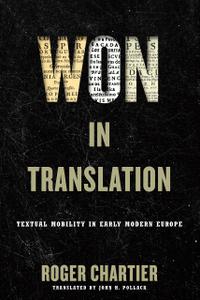
Won in Translation: Textual Mobility in Early Modern Europe (Material Texts) by Roger Chartier, translated by John H. Pollack
English | May 24, 2022 | ISBN: 0812253833 | True EPUB | 192 pages | 1.5 MB
In Won in Translation Roger Chartier, one of the world's leading historians of books, publishing, and reading, considers the mobility of the early modern text and the plurality of circulating versions of the same work. The agent for both is translation, for through their lexical, aesthetic, and cultural decisions, translators always assign new meaning or new status to what they translate.
Won in Translation proceeds by way of four case studies, three dedicated to works originally in Spanish, the fourth to a Portuguese dramatic adaptation of Don Quixote. Bartolomé de Las Casas' Brevísima relación de la destrucción de las Indias, first printed in 1552, was a powerful instrument for the construction of what was later called the "black legend" of Spanish monarchy. Baltasar Gracián's Oráculo Manual, published in 1647, became the most famous courtier's manual in Europe. Both traveled more widely and were translated more often than any other books of their era. For Chartier they illustrate the great power of translation, which allowed Las Casas' account to be placed in multiple and successive contexts and enabled Gracián's book to take on a range of meanings it had not originally had. Chartier's next two chapters are devoted to plays, one by Lope de Vega, the other by Antônio José da Silva. In the case of Lope's Fuente Ovejuna, the "translation" was one from historical chronicle to dramatic performance. In Antônio José da Silva's Vida do Grande D. Quixote, the textual migration is twofold, as Cervantes' hero moves from Spanish to Portuguese and from novel to play.
In an Epilogue, Chartier moves three centuries forward to consider the paradox that it is the absolute immobility of the text, "reinvented" word for word, that creates its mobility in Jorge Luis Borges' fiction "Pierre Menard, Author of the Quixote." Works are transformed through changes of genre or language, to be sure; but even when the texts remain fixed, their readers give them different or inverted meaning.

Download From UploadCloud
https://www.uploadcloud.pro/rnf58p03r1ab/8ay5s.W.i.T.T.M.i.E.M.E.rar.html
Download From NovaFile
https://nfile.cc/7QnM6Jlj/8ay5s.W.i.T.T.M.i.E.M.E.rar
![]()
https://rapidgator.net/file/e41e0f844fc1cda2d194fbab33b7ffd1/8ay5s.W.i.T.T.M.i.E.M.E.rar.html
![]()
https://nitroflare.com/view/19EE6BBE980C0CA/8ay5s.W.i.T.T.M.i.E.M.E.rar
![]()
https://uploadgig.com/file/download/3901d23E160a9d7d/8ay5s.W.i.T.T.M.i.E.M.E.rar
https://www.uploadcloud.pro/rnf58p03r1ab/8ay5s.W.i.T.T.M.i.E.M.E.rar.html
Download From NovaFile
https://nfile.cc/7QnM6Jlj/8ay5s.W.i.T.T.M.i.E.M.E.rar

https://rapidgator.net/file/e41e0f844fc1cda2d194fbab33b7ffd1/8ay5s.W.i.T.T.M.i.E.M.E.rar.html

https://nitroflare.com/view/19EE6BBE980C0CA/8ay5s.W.i.T.T.M.i.E.M.E.rar

https://uploadgig.com/file/download/3901d23E160a9d7d/8ay5s.W.i.T.T.M.i.E.M.E.rar
Please Help Me Click Connect Icon Below Here and Share News to Social Network | Thanks you !
Help Us Grow – Share, Support
We need your support to keep providing high-quality content and services. Here’s how you can help:
- Share Our Website on Social Media! 📱
Spread the word by sharing our website on your social media profiles. The more people who know about us, the better we can serve you with even more premium content! - Get a Premium Filehost Account from Website! 🚀
Tired of slow download speeds and waiting times? Upgrade to a Premium Filehost Account for faster downloads and priority access. Your purchase helps us maintain the site and continue providing excellent service.
Thank you for your continued support! Together, we can grow and improve the site for everyone. 🌐
Related News
-
{related-news}
Comments (0)

Information
Users of Guests are not allowed to comment this publication.
Search
Updates
Partner
» TutBB
» Byte
» Crawli
» Warezomen
» Warez-DDL
» Raidrush
» KATZCD
» Free Ebooks Library
Your Link Here ?
(Pagerank 4 or above)
» Byte
» Crawli
» Warezomen
» Warez-DDL
» Raidrush
» KATZCD
» Free Ebooks Library
Your Link Here ?
(Pagerank 4 or above)