



E-Books →Shostakovich in Dialogue
Published by: Baturi on 15-03-2022, 05:38 |  0
0
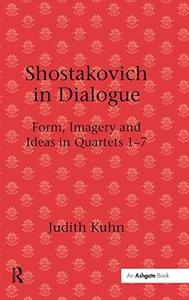
Shostakovich in Dialogue By Judith Kuhn
2010 | 315 Pages | ISBN: 0754664066 | PDF | 6 MB
A thorough examination of Shostakovich's string quartets is long overdue. Although they can justifiably lay claim to being the most significant and frequently performed twentieth-century oeuvre for that ensemble, there has been no systematic English-language study of the entire cycle. Judith Kuhn's book begins such a study, undertaken with the belief that, despite a growing awareness of the universality of Shostakovich's music, much remains to be learned from the historical context and an examination of the music's language. Much of the controversy about Shostakovich's music has been related to questions of meaning. The conflicting interpretations put forth by scholars during the musicological 'Shostakovich wars' have shown the impossibility of fixing a single meaning in the composer's music. Commentators have often heard the quartets as political in nature, although there have been contradictory views as to whether Shostakovich was a loyal communist or a dissident. The works are also often described as vivid narratives, perhaps a confessional autobiography or a chronicle of the composer's times. The cycle has also been heard to examine major philosophical issues posed by the composer's life and times, including war, death, love, the conflict of forces of good and evil, the nature of subjectivity, the power of creativity and the place of the individual - and particularly the artist - in society. Soviet commentaries on the quartets typically describe the works through the lens of Socialist-Realist mythological master narratives. Recent Western commentaries see Shostakovich's quartets as expressions of broader twentieth-century subjectivity, filled with ruptures and uncertainty. What musical features enable these diverse interpretations? Kuhn examines each quartet in turn, looking first at its historical and biographical context, with special attention to the cultural questions being discussed at the time of its writing. She then surveys the work's reception history, and follows with a critical discussion of the quartet's architectural and harmonic features. Using the new tools of Sonata Theory, Kuhn provides a fresh analytical approach to Shostakovich's music, giving valuable and detailed insights into the quartets, showing how the composer's mastery of form has enabled these works to be heard as active participants in the Soviet and Western cultural discourses of their time, while remaining compelling and relevant to twenty-first-century listeners.




Help Us Grow – Share, Support
We need your support to keep providing high-quality content and services. Here’s how you can help:
- Share Our Website on Social Media! 📱
Spread the word by sharing our website on your social media profiles. The more people who know about us, the better we can serve you with even more premium content! - Get a Premium Filehost Account from Website! 🚀
Tired of slow download speeds and waiting times? Upgrade to a Premium Filehost Account for faster downloads and priority access. Your purchase helps us maintain the site and continue providing excellent service.
Thank you for your continued support! Together, we can grow and improve the site for everyone. 🌐
Related News
-
{related-news}
Comments (0)

Information
Users of Guests are not allowed to comment this publication.
Search
Updates
Partner
» TutBB
» Byte
» Crawli
» Warezomen
» Warez-DDL
» Raidrush
» KATZCD
» Free Ebooks Library
Your Link Here ?
(Pagerank 4 or above)
» Byte
» Crawli
» Warezomen
» Warez-DDL
» Raidrush
» KATZCD
» Free Ebooks Library
Your Link Here ?
(Pagerank 4 or above)