



E-Books →Helping Victims of Violent Crime
Published by: Baturi on 15-03-2022, 05:31 |  0
0
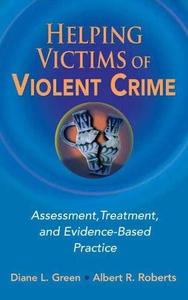
Helping Victims of Violent Crime By Diane L. Green PhD, Albert R. Roberts DSW, PhD
2008 | 279 Pages | ISBN: 0826125085 | PDF | 3 MB
Over the past two decades, violent crime has become one of the most serious domestic problems in the United States. Approximately 13 million people (nearly 5% of the U.S. population) are victims of crime every year, and of that, approximately one and a half million are victims of violent crime. Ensuring quality of life for victims of crime is therefore a major challenge facing policy makers and mental health providers. Helping Victims of Violent Crime grounds victim assistance treatments in a victim-centered and strengths perspective. The book explores victim assistance through systems theory: the holistic notion of examining the client in his/her environment and a key theoretical underpinning of social work practice. The basic assumption of systems theoryis homeostasis. A crime event causes a change in homeostasis and often results in disequilibrium. The victim's focus at this point is to regain equilibrium. Under the systems metatheory, coping, crisis and attribution theories provide a good framework for victim-centered intervention. Stress and coping theories posit that three factors determine the state of balance: perception of the event, available situational support, and coping mechanisms. Crisis theory offers a framework to understand a victim's response to a crime. The basic assumption of crisis theory asserts that when a crisis occurs, people respond with a fairly predictable physical and emotional pattern. The intensity and manifestation of this pattern may vary from individual to individual. Finally, attribution theory asserts that individuals make cognitive appraisals of a stressful situation in both positive and negative ways. These appraisals are based on the individual's assertion that they can understand, predict, and control circumstances and result in the victim's assignment of responsibility for solving or helping with problems that have arisen from the crime event. In summary, these four theories can delineate a definitive model for approach to the victimization process. It is from this theoretical framework that Treating Victims of Violent Crime offers assessments and interventions with a fuller understanding of the victimization recovery process. The book includes analysis of victims of family violence (child abuse, elder abuse, partner violence) as well as stranger violence (sexual assault, homicide, and terrorism).




Help Us Grow – Share, Support
We need your support to keep providing high-quality content and services. Here’s how you can help:
- Share Our Website on Social Media! 📱
Spread the word by sharing our website on your social media profiles. The more people who know about us, the better we can serve you with even more premium content! - Get a Premium Filehost Account from Website! 🚀
Tired of slow download speeds and waiting times? Upgrade to a Premium Filehost Account for faster downloads and priority access. Your purchase helps us maintain the site and continue providing excellent service.
Thank you for your continued support! Together, we can grow and improve the site for everyone. 🌐
Related News
-
{related-news}
Comments (0)

Information
Users of Guests are not allowed to comment this publication.
Search
Updates
Partner
» TutBB
» Byte
» Crawli
» Warezomen
» Warez-DDL
» Raidrush
» KATZCD
» Free Ebooks Library
Your Link Here ?
(Pagerank 4 or above)
» Byte
» Crawli
» Warezomen
» Warez-DDL
» Raidrush
» KATZCD
» Free Ebooks Library
Your Link Here ?
(Pagerank 4 or above)