



E-Books →Generated Dynamics of Markov and Quantum Processes
Published by: Baturi on 10-08-2021, 06:27 |  0
0
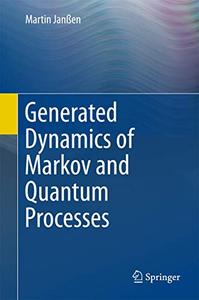
Generated Dynamics of Markov and Quantum Processes by Martin Janßen
English | PDF,EPUB | 2016 | 236 Pages | ISBN : 3662496941 | 7.1 MB
This book presents Markov and quantum processes as two sides of a coin called generated stochastic processes. It deals with quantum processes as reversible stochastic processes generated by one-step unitary operators, while Markov processes are irreversible stochastic processes generated by one-step stochastic operators. The characteristic feature of quantum processes are oscillations, interference, lots of stationary states in bounded systems and possible asymptotic stationary scattering states in open systems, while the characteristic feature of Markov processes are relaxations to a single stationary state.
Quantum processes apply to systems where all variables, that control reversibility, are taken as relevant variables, while Markov processes emerge when some of those variables cannot be followed and are thus irrelevant for the dynamic description. Their absence renders the dynamic irreversible.
A further aim is to demonstrate that almost any subdiscipline of theoretical physics can conceptually be put into the context of generated stochastic processes. Classical mechanics and classical field theory are deterministic processes which emerge when fluctuations in relevant variables are negligible. Quantum mechanics and quantum field theory consider genuine quantum processes. Equilibrium and non-equilibrium statistics apply to the regime where relaxing Markov processes emerge from quantum processes by omission of a large number of uncontrollable variables. Systems with many variables often self-organize in such a way that only a few slow variables can serve as relevant variables. Symmetries and topological classes are essential in identifying such relevant variables.
The third aim of this book is to provide conceptually general methods of solutions which can serve as starting points to find relevant variables as to apply best-practice approximation methods. Such methods are available through generating functionals.
The potential reader is a graduate student who has heard already a course in quantum theory and equilibrium statistical physics including the mathematics of spectral analysis (eigenvalues, eigenvectors, Fourier and Laplace transformation). The reader should be open for a unifying look on several topics.
Dear Visitors,
So YourSupportFor Me Will come WithoutLoosingAnything And I Keep Posting For You
Thanks For YourSupport.
Buy Premium From My Links To Get Resumable Support,Max Speed & Support Me

https://rapidgator.net/file/3893f9caab4ba174818162d5ad40870a/nmv37.3662496941.epub.rar[/url].html
https://rapidgator.net/file/94bb2c9b63b2602f69d3a129a56c601c/nmv37.3662496941.pdf.rar[/url].html

http://nitro.download/view/40FFD859E1D45C2/nmv37.3662496941.epub.rar[/url]
http://nitro.download/view/088350170829BA0/nmv37.3662496941.pdf.rar[/url]

https://uploadgig.com/file/download/F98f13bA3cBe6Ee1/nmv37.3662496941.epub.rar[/url]
https://uploadgig.com/file/download/9d42b881d76Fc2Ac/nmv37.3662496941.pdf.rar[/url]
Help Us Grow – Share, Support
We need your support to keep providing high-quality content and services. Here’s how you can help:
- Share Our Website on Social Media! 📱
Spread the word by sharing our website on your social media profiles. The more people who know about us, the better we can serve you with even more premium content! - Get a Premium Filehost Account from Website! 🚀
Tired of slow download speeds and waiting times? Upgrade to a Premium Filehost Account for faster downloads and priority access. Your purchase helps us maintain the site and continue providing excellent service.
Thank you for your continued support! Together, we can grow and improve the site for everyone. 🌐
Related News
-
{related-news}
Comments (0)

Information
Users of Guests are not allowed to comment this publication.
Search
Updates
Partner
» TutBB
» Byte
» Crawli
» Warezomen
» Warez-DDL
» Raidrush
» KATZCD
» Free Ebooks Library
Your Link Here ?
(Pagerank 4 or above)
» Byte
» Crawli
» Warezomen
» Warez-DDL
» Raidrush
» KATZCD
» Free Ebooks Library
Your Link Here ?
(Pagerank 4 or above)