



E-Books →Computational Paralinguistics Emotion, Affect and Personality in Speech and Language Processing
Published by: Baturi on 28-07-2021, 01:55 |  0
0
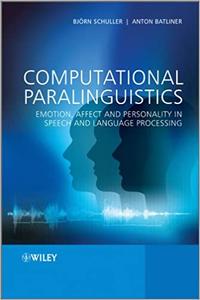
Björn Schuller, Anton Batliner, "Computational Paralinguistics: Emotion, Affect and Personality in Speech and Language Processing"
English | 2013 | pages: 345 | ISBN: 1119971365 | PDF | 5,2 mb
This book presents the methods, tools and techniques that are currently being used to recognise (automatically) the affect, emotion, personality and everything else beyond linguistics ('paralinguistics') expressed by or embedded in human speech and language.
It is the first book to provide such a systematic survey of paralinguistics in speech and language processing. The technology described has evolved mainly from automatic speech and speaker recognition and processing, but also takes into account recent developments within speech signal processing, machine intelligence and data mining.
Moreover, the book offers a hands-on approach by integrating actual data sets, software, and open-source utilities which will make the book invaluable as a teaching tool and similarly useful for those professionals already in the field.
Key features:
- Provides an integrated presentation of basic research (in phonetics/linguistics and humanities) with state-of-the-art engineering approaches for speech signal processing and machine intelligence.
- Explains the history and state of the art of all of the sub-fields which contribute to the topic of computational paralinguistics.
- C overs the signal processing and machine learning aspects of the actual computational modelling of emotion and personality and explains the detection process from corpus collection to feature extraction and from model testing to system integration.
- Details aspects of real-world system integration including distribution, weakly supervised learning and confidence measures.
- Outlines machine learning approaches including static, dynamic and context‑sensitive algorithms for classification and regression.
- Includes a tutorial on freely available toolkits, such as the open-source 'openEAR' toolkit for emotion and affect recognition co-developed by one of the authors, and a listing of standard databases and feature sets used in the field to allow for immediate experimentation enabling the reader to build an emotion detection model on an existing corpus.
Buy Premium From My Links To Get Resumable Support,Max Speed & Support Me

https://uploadgig.com/file/download/a8d46Fa632067fe5/827g0.Computational.Paralinguistics.Emotion.Affect.and.Personality.in.Speech.and.Language.Processing.rar

https://rapidgator.net/file/5881ef25b8ff3d2d683f9250f23d9b6b/827g0.Computational.Paralinguistics.Emotion.Affect.and.Personality.in.Speech.and.Language.Processing.rar.html

http://nitro.download/view/DB80C0B28048E90/827g0.Computational.Paralinguistics.Emotion.Affect.and.Personality.in.Speech.and.Language.Processing.rar
Help Us Grow – Share, Support
We need your support to keep providing high-quality content and services. Here’s how you can help:
- Share Our Website on Social Media! 📱
Spread the word by sharing our website on your social media profiles. The more people who know about us, the better we can serve you with even more premium content! - Get a Premium Filehost Account from Website! 🚀
Tired of slow download speeds and waiting times? Upgrade to a Premium Filehost Account for faster downloads and priority access. Your purchase helps us maintain the site and continue providing excellent service.
Thank you for your continued support! Together, we can grow and improve the site for everyone. 🌐
Related News
-
{related-news}
Comments (0)

Information
Users of Guests are not allowed to comment this publication.
Search
Updates
Partner
» TutBB
» Byte
» Crawli
» Warezomen
» Warez-DDL
» Raidrush
» KATZCD
» Free Ebooks Library
Your Link Here ?
(Pagerank 4 or above)
» Byte
» Crawli
» Warezomen
» Warez-DDL
» Raidrush
» KATZCD
» Free Ebooks Library
Your Link Here ?
(Pagerank 4 or above)