



E-Books →Agents of World Renewal The Rise of Yonaoshi Gods in Japan
Published by: Baturi on 27-01-2021, 05:58 |  0
0
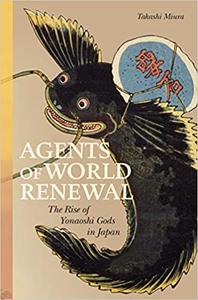
Professor Takashi Miura, "Agents of World Renewal: The Rise of Yonaoshi Gods in Japan"
English | ISBN: 0824880374 | 2019 | 246 pages | EPUB | 2 MB
This volume examines a category of Japanese divinities that centered on the concept of "world renewal" (yonaoshi). In the latter half of the Tokugawa period (1603-1867), a number of entities, both natural and supernatural, came to be worshipped as "gods of world renewal." These included disgruntled peasants who demanded their local governments repeal unfair taxation, government bureaucrats who implemented special fiscal measures to help the poor, and a giant subterranean catfish believed to cause earthquakes to punish the hoarding rich. In the modern period, yonaoshi gods took on more explicitly anti-authoritarian characteristics. During a major uprising in Saitama Prefecture in 1884, a yonaoshi god was invoked to deny the legitimacy of the Meiji regime, and in the late nineteenth and early twentieth centuries, the new religion Ōmoto predicted an apocalyptic end of the world presided over by a messianic yonaoshi god.
Using a variety of local documents to analyze the veneration of yonaoshi gods, Takashi Miura looks beyond the traditional modality of research focused on religious professionals, their institutions, and their texts to illuminate the complexity of a lived religion as practiced in communities. He also problematizes the association frequently drawn between the concept of yonaoshi and millenarianism, demonstrating that yonaoshi gods served as divine rectifiers of specific economic injustices and only later, in the modern period and within the context of new religions such as Ōmoto, were fully millenarian interpretations developed. The scope of world renewal, in other words, changed over time.
Agents of World Renewal approaches Japanese religion through the new analytical lens of yonaoshi gods and highlights the necessity of looking beyond the boundary often posited between the early modern and modern periods when researching religious discourses and concepts.
Buy Premium From My Links To Get Resumable Support,Max Speed & Support Me

https://uploadgig.com/file/download/781dec395c76d928/jjif5.Agents.of.World.Renewal.The.Rise.of.Yonaoshi.Gods.in.Japan.rar

https://rapidgator.net/file/102c6a2db7d3d2a7045a19ad95156027/jjif5.Agents.of.World.Renewal.The.Rise.of.Yonaoshi.Gods.in.Japan.rar.html

http://nitroflare.com/view/5A160583C5226ED/jjif5.Agents.of.World.Renewal.The.Rise.of.Yonaoshi.Gods.in.Japan.rar
Help Us Grow – Share, Support
We need your support to keep providing high-quality content and services. Here’s how you can help:
- Share Our Website on Social Media! 📱
Spread the word by sharing our website on your social media profiles. The more people who know about us, the better we can serve you with even more premium content! - Get a Premium Filehost Account from Website! 🚀
Tired of slow download speeds and waiting times? Upgrade to a Premium Filehost Account for faster downloads and priority access. Your purchase helps us maintain the site and continue providing excellent service.
Thank you for your continued support! Together, we can grow and improve the site for everyone. 🌐
Related News
-
{related-news}
Comments (0)

Information
Users of Guests are not allowed to comment this publication.
Search
Updates
Partner
» TutBB
» Byte
» Crawli
» Warezomen
» Warez-DDL
» Raidrush
» KATZCD
» Free Ebooks Library
Your Link Here ?
(Pagerank 4 or above)
» Byte
» Crawli
» Warezomen
» Warez-DDL
» Raidrush
» KATZCD
» Free Ebooks Library
Your Link Here ?
(Pagerank 4 or above)