



E-Books →An Evaluation of the Aerial Interdiction Campaign Known as the Transportation Plan For the D-Day Invasion
Published by: book24h on 25-02-2023, 14:40 |  0
0
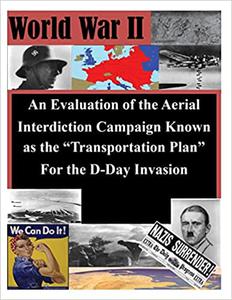
Air Command and General Staff College, "An Evaluation of the Aerial Interdiction Campaign Known as the "Transportation Plan" For the D-Day Invasion "
English | ISBN: 1500162981 | 2014 | 48 pages | EPUB | 503 KB
The various airmen leading the air war had great differences of opinion regarding what to target in the European theater of operations in support of Operation Overlord. The central leadership figures were Lt. General Carl Spaatz, USSTAF commander, and Air Chief Marshal Trafford Leigh-Mallory, AEAF commander. Each of these military men obviously wanted to support the planned Allied invasion, but they held differing opinions in regard to how to best support the invasion troops. They were greatly influenced by both personal experience and the advice of their respective scientific advisors, Walt W. Rostow and Dr. Solly Zuckerman. Also, Air Marshal Tedder, Deputy Supreme Allied Commander, and Air Marshal Harris, Commander of the RAF Bomber Command, contributed to the decisions to carry out the transportation interdiction campaign.This research focuses on the period January 1944 through the end of June 1944. It includes a literature review of published memoirs and historic accounts of the individuals involved in the decision to implement the transportation plan. The archives of the Air Force Historical Research Agency were accessed to obtain actual accounts and directives implementing the pre-D-Day interdiction campaign. Numerous facts support a discussion of each of the airmen's interests and the controversy that surrounded the transportationcampaign.The implementation of the transportation interdiction campaign resulted in thesuccessful denial of German reinforcements to the Normandy beachhead. This success was a result of five significant factors. These were as follows: 1) the vast numbers of Allied aircraft relative to the Germans helped achieve and maintain air superiority; 2) the increased variety of targets which were attacked in implementation of the transportation plan; 3) the oil campaign with its impact on German aircraft availability and quality of German combat pilots; 4) the German's indecision to commit their reserves based on the belief that the real invasion had not yet occurred; and 5) the impact of the scientific advisors on the military leadership's decisions. These factors were crucial in contributing to the success of the transportation plan in support of the D-Day invasion.
Read more

Rapidgator
fmu3z.A.E.o.t.A.I.C.K.a.t.T.P.F.t.D.I.rar.html
NitroFlare
fmu3z.A.E.o.t.A.I.C.K.a.t.T.P.F.t.D.I.rar
Uploadgig
fmu3z.A.E.o.t.A.I.C.K.a.t.T.P.F.t.D.I.rar
Please Help Me Click Connect Icon Below Here and Share News to Social Network | Thanks you !
Help Us Grow – Share, Support
We need your support to keep providing high-quality content and services. Here’s how you can help:
- Share Our Website on Social Media! 📱
Spread the word by sharing our website on your social media profiles. The more people who know about us, the better we can serve you with even more premium content! - Get a Premium Filehost Account from Website! 🚀
Tired of slow download speeds and waiting times? Upgrade to a Premium Filehost Account for faster downloads and priority access. Your purchase helps us maintain the site and continue providing excellent service.
Thank you for your continued support! Together, we can grow and improve the site for everyone. 🌐
Related News
-
{related-news}
Comments (0)

Information
Users of Guests are not allowed to comment this publication.
Search
Updates
Partner
» TutBB
» Byte
» Crawli
» Warezomen
» Warez-DDL
» Raidrush
» KATZCD
» Free Ebooks Library
Your Link Here ?
(Pagerank 4 or above)
» Byte
» Crawli
» Warezomen
» Warez-DDL
» Raidrush
» KATZCD
» Free Ebooks Library
Your Link Here ?
(Pagerank 4 or above)