



E-Books →Imagining Exile in Heian Japan Banishment in Law, Literature, and Cult
Published by: Baturi on 20-03-2022, 09:31 |  0
0
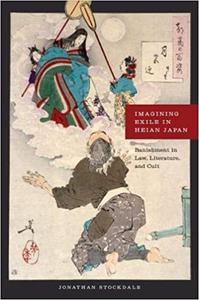
Jonathan Stockdale, "Imagining Exile in Heian Japan: Banishment in Law, Literature, and Cult"
English | ISBN: 0824839838 | 2015 | 192 pages | PDF | 1510 KB
For over three hundred years during the Heian period (794-1185), execution was customarily abolished in favor of banishment. During the same period, exile emerged widely as a concern within literature and legend, in poetry and diaries, and in the cultic imagination, as expressed in oracles and revelations. While exile was thus one sanction available to the state, it was also something more: a powerful trope through which members of court society imagined the banishment of gods and heavenly beings, of legendary and literary characters, and of historical figures, some transformed into spirits.
This compelling and well-researched volume is the first in English to explore the rich resonance of exile in the cultural life of the Japanese court. Rejecting the notion that such narratives merely reflect a timeless literary archetype, Jonathan Stockdale shows instead that in every case narratives of exile emerged from particular historical circumstances―moments in which elites in the capital sought to reveal and to re-imagine their world and the circulation of power within it. By exploring the relationship of banishment to the structures of inclusion and exclusion upon which Heian court society rested, Stockdale moves beyond the historiographical discussion of "center and margin" to offer instead a theory of exile itself.
Stockdale's arguments are situated in astute and careful readings of Heian sources. His analysis of a literary narrative, the , for example, shows how Kaguyahime's exile from the "Capital of the Moon" to earth implicitly portrays the world of the Heian court as a polluted periphery. His exploration of one of the most well-known historical instances of banishment, that of Sugawara Michizane, illustrates how the political sanction of exile could be met with a religious rejoinder through which an exiled noble is reinstated in divine form, first as a vengeful spirit and then as a deity worshipped at the highest levels of court society.
is a model of interdisciplinary scholarship that will appeal to anyone interested in the interwoven connections among the literature, politics, law, and religion of early and classical Japan.
Read more

https://hot4share.com/inqamevwuiny/asb6n.I.E.i.H.J.B.i.L.L.a.C.rar.html

https://rapidgator.net/file/0d741079efa5ed5369e425d1a2333c98/asb6n.I.E.i.H.J.B.i.L.L.a.C.rar.html

https://uploadgig.com/file/download/9e9e23463166F487/asb6n.I.E.i.H.J.B.i.L.L.a.C.rar

https://nitro.download/view/C6072D37F54913B/asb6n.I.E.i.H.J.B.i.L.L.a.C.rar
Help Us Grow – Share, Support
We need your support to keep providing high-quality content and services. Here’s how you can help:
- Share Our Website on Social Media! 📱
Spread the word by sharing our website on your social media profiles. The more people who know about us, the better we can serve you with even more premium content! - Get a Premium Filehost Account from Website! 🚀
Tired of slow download speeds and waiting times? Upgrade to a Premium Filehost Account for faster downloads and priority access. Your purchase helps us maintain the site and continue providing excellent service.
Thank you for your continued support! Together, we can grow and improve the site for everyone. 🌐
Related News
-
{related-news}
Comments (0)

Information
Users of Guests are not allowed to comment this publication.
Search
Updates
Partner
» TutBB
» Byte
» Crawli
» Warezomen
» Warez-DDL
» Raidrush
» KATZCD
» Free Ebooks Library
Your Link Here ?
(Pagerank 4 or above)
» Byte
» Crawli
» Warezomen
» Warez-DDL
» Raidrush
» KATZCD
» Free Ebooks Library
Your Link Here ?
(Pagerank 4 or above)